







Marc Darrow, MD, JD.
In the research below, doctors discuss the problem of patients who expect a poor outcome to their knee replacement and how this pre-disposes them to pain after the knee replacement. Why would someone expect a poor outcome after knee replacement? One possible answer is that the person had a lot of pain for many years, nothing has helped them, and, they have reached a point where they do not believe anything can help them. For some, this can be called pain catastrophizing.
In this April 2022 study (1) doctors write: “Preoperative emotional states and treatment expectations are significant predictors of postoperative pain. The relationship between emotional states and postoperative pain is mediated by negative treatment expectations. Therefore, innovative treatment strategies to reduce postoperative pain should focus on eliminating negative treatment expectation through establishing a differentiated preoperative expectation management program that also focuses on emotional states.”
A June 2022 study (2) examines “pain catastrophizing,” a maladaptive cognitive strategy that is associated with increased emotional responses and poor pain outcomes. Total knee replacement procedures are on the rise and 20% of those who have the procedure go on to have ongoing pain. Pain catastrophizing complicates this pain and management of this is important for recovery from surgery and prevention of chronic pain. Pain catastrophizing is a modifiable characteristic. Several interventions show modest benefit, however more research is needed to aid in clinical decision-making for this population. Interventions are most likely to produce benefits when they are targeted to people with high levels of Pain catastrophizing.
An answer may be found in a May 2022 paper (3) which examined previously published research on patient reported outcomes following less than hoped for knee replacement success.
What the researchers found were recurring themes among patients. These themes stressed that the recovery following knee replacement was not as easy as the patents thought it would be. Many patients were on painkillers and this gave them concerns including the “perceived stigma.” In the need to take them. The fact that many patients described the recovery as a “need to endure” and that their concerns were dismissed and practical support was missing from their doctors.
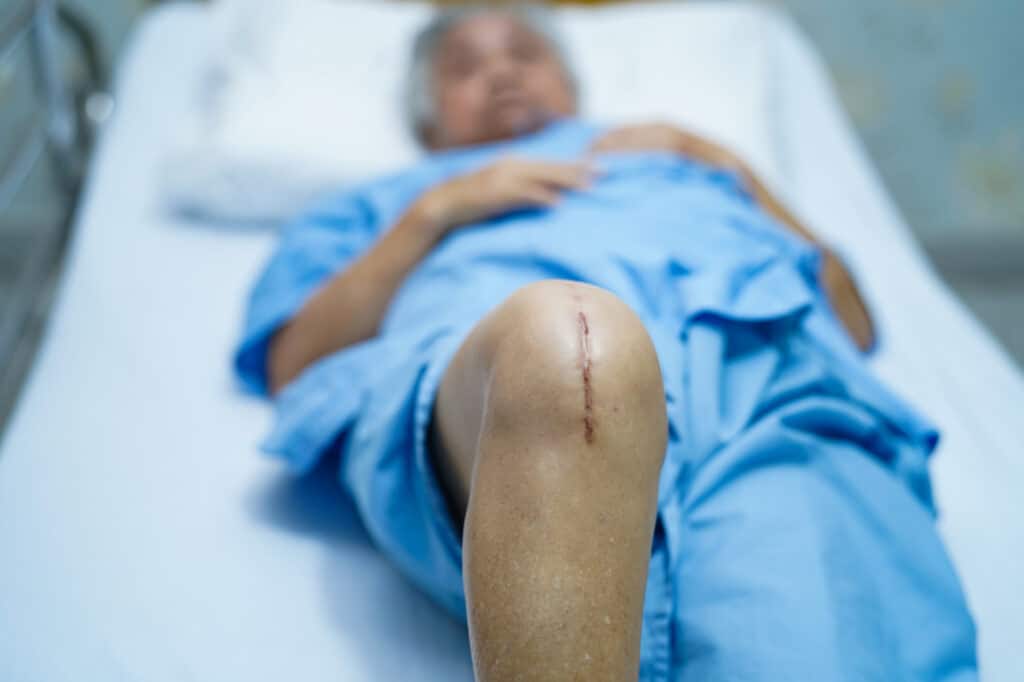
A June 2022 paper (4) notes that “Prior research has suggested that self-efficacy, positive affect, vigor, and vitality may function as resilience factors in the face of chronic pain.” In this paper, the researchers examined these resilience factors in a prospective, cognitive-affective-behavioral pathway to recovery. In this study 110 patients undergoing unilateral, total knee replacement surgery completed self-report assessments of study variables.
- Self-efficacy was assessed 2 one-half weeks prior to surgery, positive affect the day after surgery, vitality and vigor one-month following surgery, and post-operative pain at one- and three-months following surgery.
- Analysis revealed significant coefficients from pre-operative self-efficacy to positive affect during hospitalization, as well as to vitality and vigor at one-month following surgery.
There are many studies connecting weight and knee replacement failure. Many total knee replacement patients are overweight or obese. There is a thinking among many that after the knee replacement, their physical activity levels and weight will improve. This does not appear to be true for some as research points out. In many knee replacement patients, weight loss does not occur. In my article Research: Knee replacements do not help you lose weight, I discuss many of these studies patients suffered from knee pain, loss of knee function, swelling, and an inability to walk or stand for any length of time, but thought that knee replacement would help restore their activities and thereby they could lose weight. For many people, this is not what happens, research cited in my article shows “the majority of total knee replacement patients are overweight or obese and physical activity levels and weight do not appear to change in a high proportion of patients after knee replacement.”
Patient anxiety, depression, sleep were associated with postoperative knee replacement symptoms and dissatisfaction
A May 2024 paper (5) found patient anxiety and depression were associated with postoperative knee replacement symptoms and dissatisfaction. The researchers of this study found anxiety or depression increased the risk of dissatisfaction preoperatively and postoperatively. Patients younger than 65 years reported preoperative anxiety or depression to a greater extent but did not have an increased risk of dissatisfaction. The researchers concluded: “Patient-reported anxiety or depression preoperatively and postoperatively are important and potentially treatable factors to consider, as they were found to increase the risk of dissatisfaction after total knee replacement despite improvements in pain or function.”
There were 8,745 patients who participated in this research, 11% were defined as dissatisfied. The proportion of patients who reported anxiety or depression was 35% preoperatively and 17% postoperatively.
A November 2024 study (6) found “Poor sleeping quality rate was 54% for the pre-operative patients and was still 53% at one year after surgery.”
If you have chronic knee pain, have had painkillers, physical therapy, and other conservative care options that have not helped, and, now you are being told to have another surgery, we may be able to help reduce pain and increase function non-surgically. Regenerative medicine injections may be an alternative for you. Many people benefit from these treatments, but, they do not work for everyone. Will it work for you? Get a FREE phone consultation.
Call for a free phone consultation with our staff 800-300-9300
Related articles
Do Women Have More Knee Replacement Complications? Joint Rehab | Los Angeles
References
1 Suhlreyer J, Klinger R. The Influence of Preoperative Mood and Treatment Expectations on Early Postsurgical Acute Pain After a Total Knee Replacement. Frontiers in Psychiatry. 2022;13.
2 Patel RM, Anderson BL, Bartholomew JB. Interventions to Manage Pain Catastrophizing Following Total Knee Replacement: A Systematic Review. Journal of Pain Research. 2022;15:1679.
3 Taylor CE, Murray CM, Stanton TR. Patient perspectives of pain and function after knee replacement: a systematic review and meta-synthesis of qualitative studies. Pain reports. 2022 May;7(3).
4 Cremeans-Smith JK, Greene K, Delahanty DL. Resilience and recovery from total knee arthroplasty (TKA): a pathway for optimizing patient outcomes. Journal of Behavioral Medicine. 2022 Feb 13:1-9.
5 Heijbel S, Annette W, Josefine E, Hedström M. Patient-Reported Anxiety or Depression Increased the Risk of Dissatisfaction Despite Improvement in Pain or Function Following Total Knee Arthroplasty: A Swedish Register-Based Observational Study of 8,745 Patients. The Journal of Arthroplasty. 2024 May 1.
6 Daxhelet J, Delfosse G, Lavand’homme P, Fennema P, Thienpont E. Evolution and characteristics of nocturnal knee pain after knee arthroplasty. Archives of Orthopaedic and Trauma Surgery. 2024 Nov;144(11):4715-23.