







Marc Darrow, MD. JD.
A recent study (1) discusses the problem orthopedists and surgeons have in presenting treatment options to their patients with advanced ankle osteoarthritis. As many doctors and patients are aware, ankle osteoarthritis treatment protocols have no real guideline recommendations of its own. Researchers say most doctors treat an ankle problem as they would treat a knee or hip and follow hip or knee treatment protocols when treating the ankle. Why is there concern with this approach? The concern is that these are the same guidelines of conservative care protocols that ultimately lead to patient pain management programs until such time that the knee or hip can be ultimately replaced. The difference in treating an ankle like a hip or an ankle like a knee is that doctors feel that if conservative care options do not work for knee or hip osteoarthritis, there is a reasonably reliable surgical option in total knee or hip replacement. The same reasonably reliable surgical option, researchers suggests, may not be available for ankle replacement.
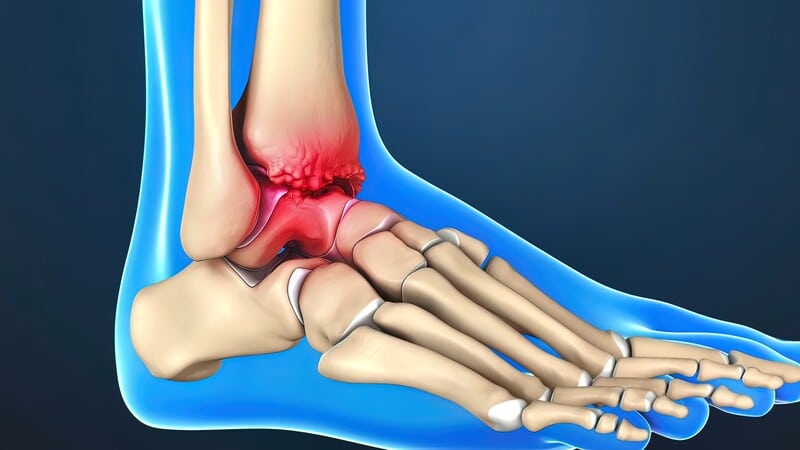
The risks and rewards of ankle arthrodesis or ankle fusion and total ankle replacement.
As we will see in the research below, ankle replacement does not have the same level of success seen in knee or hip replacement. Nor does ankle fusion.
Recent research in the British medical bulletin (2) discuss the risks and rewards of ankle arthrodesis or ankle fusion and total ankle replacement.
- Total ankle replacement while an accepted treatment for end-stage ankle osteoarthritis has a higher need for revision surgery than ankle fusion.
- While surgical outcome results are gradually improving, Total ankle replacement cannot yet be recommended for the routine management of ankle osteoarthritis.
A June 2023 paper (3) sheds more light on the concerns surrounding these two procedures. “Total ankle replacement had advantages over ankle fusion in the short term due to better performance in terms of self-reported patient outcomes, complications, and reoperation rates, but (Total ankle replacement) complications become a disadvantage in the medium term. In the long term, ankle fusion seems to be favored because of lower complications and revision rates, although there is no difference in clinical scores.”
A September 2022 study (4) continued to analyze the differences in the rates of complications and reoperations at both 30 days and one year within a matched sample of total ankle replacement and ankle arthrodesis (fusion) patients from a large database population. After matching both total ankle replacement and ankle fusion groups for confounding variables, such as diabetes, smoking, obesity, and comorbidities scores, the differences in the rates of complications at 30 days and one year found the rate of surgical site infection and wound dehiscence (open wound) were higher at 30 days in the fusion group. About 63.45% of complications happened after 30 days. The fusion group showed a higher rate of surgical site infection, wound dehiscence, mechanical complications, and pneumonia at one year. The rate of reoperation was also higher in the fusion group at one year.
A September 2023 paper (5) also advised that total ankle replacement is not suitable for the younger patient who desires to remain active in sports. “Current literature does not allow to advise total ankle replacement for (the) young and active patient who want to play sports after surgery. Selected patients undergoing total ankle replacement can return to sport after surgery, and the most approachable activities are low demanding sport. However, no strong evidence is available to support these findings (a return to sport).”
Is an ankle fusion better than an ankle replacement? Is the ankle replacement better?
In the research above we see conflicting ideas about the superiority of either of these two ankle surgeries. But what if your mind is set on surgery. Which is better? Here is an opinion from the Department of Orthopaedic Surgery, Tulane University School of Medicine published in the research January 2021. (6)
“There (is little) data comparing complications between ankle arthrodesis (fusion) versus total ankle arthroplasty (replacement) for operative management of primary osteoarthritis (osteoarthritis). This study aimed to compare outcomes following ankle arthrodesis (fusion) versus total ankle arthroplasty (replacement) for primary ankle osteoarthritis using a large patient database.
Results: A total of 1136 (67%) patients received ankle arthrodesis (fusion) and 584 (33%) patients underwent total ankle arthroplasty (replacement). Patients that received ankle arthrodesis (fusion) exhibited significantly higher rates of at least one common joint complication at 90 days, 1 year, and 2 years postoperatively. This included higher rates of adjacent fusion or osteotomy procedures, periprosthetic fractures, and hardware removal at each postoperative follow-up. Rates of prosthetic joint infection were comparable at 2 years postoperatively.
Conclusion: The ankle arthrodesis (fusion) cohort exhibited higher rates of postoperative joint complications in the short and medium-term, namely, subsequent fusions or osteotomies, periprosthetic fractures, and hardware removal.”
A May 2021 study (7) suggested total ankle replacement showed significantly greater post-operative range of motion than ankle fusion but no other differences in other patient-reported outcome scores. Patients undergoing total ankle replacement showed higher post-operative SF-36 (36 question health status survey). The total complication rate was similar between the two procedures including the incidence of re-operations.
Conclusion: While total ankle replacement and ankle fusion showed no differences in most post-operative functional outcomes, patients undergoing total ankle replacement show better health-related quality of life than ankle fusion. The study found no evidence to suggest that total ankle replacement carries a higher risk of complications and re-operations compared to ankle fusion.
Younger than 65 and obese. Two main factors for total ankle replacement
A February 2021 study (8) found that increased risk for total ankle replacement failure was seen more in patients under the age of 65, as opposed to older patients who did not have increased risk, and in patients who were obese as opposed to normal weight patients.
- Failure of total ankle replacement was defined as a patient having to then undergo revision total ankle replacement or ankle fusion procedures.
An April 2024 study (9) looked at machine learning or artificial intelligence’s ability to predict who would not have a successful ankle replacement. The researchers found “diabetes, peripheral vascular disease, teaching hospital status, morbid obesity, history of musculoskeletal infection, history of hip fracture, renal failure, implant complication, history of major fracture. . . ” as the leading pre-surgery prediction factors for whom ankle replacement would fail.
Contact us and related articles
If you have chronic ankle pain, have had painkillers, physical therapy, and other conservative care options that have not helped, and, now you are being told to have surgery. We may be able to help reduce pain and increase function.
Regenerative medicine injections may be an alternative for you. Many people benefit from these treatments, but, they do not work for everyone. Will it work for you? Get a FREE phone consultation.
Call for a free phone consultation with our staff.
800-300-9300 or 310-231-7000 or email
Stem cell therapy and ankle osteoarthritis injections | Joint Rehab Los Angeles
Article citations:
1 Paterson KL, Gates L. Clinical Assessment and Management of Foot and Ankle Osteoarthritis: A Review of Current Evidence and Focus on Pharmacological Treatment. Drugs & aging. 2019 Jan 25:1-9.
2 Maffulli N, Longo UG, Locher J, Romeo G, Salvatore G, Denaro V. Outcome of ankle arthrodesis and ankle prosthesis: a review of the current status. British Medical Bulletin. 2017 Nov 23:1-22.
3 Liu S, Wang Y, Zhang M, Wei P, Li Y, Wang T, Meng Q. A comparative study of modern total ankle replacement and ankle arthrodesis for ankle osteoarthritis at different follow-up times: a systematic review and meta-analysis. International Orthopaedics. 2023 Jun;47(6):1493-510.
4 Sambandam S, Serbin P, Riepen D, Aggarwal VA, Mounasamy V, Wukich D. Differences Between Total Ankle Replacement and Ankle Arthrodesis in Post-operative Complications and Reoperations at 30 Days and One Year. Cureus. 2022 Sep 2;14(9).
5 Arceri A, Mazzotti A, Zielli S, Bonelli S, Artioli E, Abdi P, Langone L, Faldini C. Return to sports after total ankle arthroplasty: A systematic review and meta-analysis. Journal of Orthopaedics. 2023 Sep 2.
6 Ross BJ, Savage-Elliott I, Wu VJ, Rodriguez RF. Complications Following Total Ankle Arthroplasty Versus Ankle Arthrodesis for Primary Ankle Osteoarthritis. Foot Ankle Spec. 2021 Jan 20:1938640020987741.
7 Fanelli D, Mercurio M, Castioni D, Sanzo V, Gasparini G, Galasso O. End-stage ankle osteoarthritis: arthroplasty offers better quality of life than arthrodesis with similar complication and re-operation rates—an updated meta-analysis of comparative studies. International Orthopaedics. 2021 May 4:1-5.
8 Suh DH, Han K, Lee JW, Kim HJ, Kim B, Koo BM, Kim HK, Choi GW. Risk factors associated with failure of total ankle arthroplasty: a nationwide cohort study. Scientific Reports. 2021 Feb 3;11(1):1-9.
9 Shah AA, Devana SK, Lee C, SooHoo NF. A predictive algorithm for perioperative complications and readmission after ankle arthrodesis. European Journal of Orthopaedic Surgery & Traumatology. 2024 Apr;34(3):1373-9.