







Marc Darrow, M.D.,J.D.
Many people are offered a cortisone injection to help with pain relief, inflammation, and in some cases to help their doctors identify where the source of their pain is coming from. Because of the well documented side-effects of cortisone, we cover this topic at length in my article Systemic effects of cortisone injections including cartilage damage, doctors have become less anxious to rush to these injections and in the past years alternatives including hyaluronic acid injections have been developed. But are the hyaluronic acid injections a better option?
A June 2022 paper (1) assessed the risks of intra-articular corticosteroid injections pain relief versus the possibility that the injections were accelerating the need for hip replacement. In this study patients with a diagnosis of hip pain without femoroacetabular osteoarthritis who were administered an intra-articular corticosteroid injection of the hip. This large data base included 25,073 patients who received a corticosteroid injection. The incidence of total hip arthroplasty (THA) at 5-year-follow up was significantly higher for the corticosteroid cohort compared to controls. The incidence and risk of total hip arthroplasty increased along with number of injections, the highest risk being for patients who had three or more cortisone injections.
Rapidly progressive hip osteoarthritis leading to femoral head collapse following intra-articular corticosteroid injections
A May 2024 study (2) writes: “Rapidly progressive hip osteoarthritis leading to femoral head collapse following intra-articular corticosteroid injections is a perplexing variant of osteoarthritis.: In this study, the authors “explored eight cases of chronic joint pain treated with intra-articular corticosteroid injections. Subsequently, they experienced swift deterioration of the femoral head integrity within as little as 10 weeks.” The patients exhibited various health factors, including obesity, smoking history, cancer treatment, and deficiencies in Vitamin D levels, which have been found to increase the risk of femoral head collapse.
Other studies presented a more favorable opinion on cortisone use for hip pain:
An August 2020 study (3) made these observations concerning the use of corticosteroid injections for hip osteoarthritis and compared these injections to hyaluronic acid injections:
- “Intraarticular corticosteroid injections have been used for decades, although evidence is quite scarce, and many controversies remain.”
- “Available randomized controlled trials show that intraarticular corticosteroid injections provide pain relief and functional improvement in hip osteoarthritis. This efficacy has not been shown with intraarticular hyaluronic acid injections.”
- “This review shows that intraarticular corticosteroid injections are efficacious in hip osteoarthritis and that this benefit can last up to 12 weeks.”
Summary: Cortisone injections are effective for 12 weeks and they are a better option than hyaluronic acid injections.
A December 2022 paper (4) examined previously published studies on the use of image-guided corticosteroid injections in the treatment of patients with hip osteoarthritis. The authors observed “hip injections were found to be effective in treating short- and long-term pain and more effective than hyaluronic acid, Mepivacaine, NSAIDs, and normal saline in terms of improvement in pain and/or function.”
The side-effects of cortisone
But again, we come back to the problem of cortisone’s know side-effects and the basic question, what does it cost to get 12 weeks worth of pain relief in the long-term aspect of hip osteoarthritis treatment?
One of the side-effects if corticosteroid injections given into the hip is the concern, as pointed out in a June 2021 study (5) is “that these injections may increase the risk of postoperative infection if a subsequent total hip arthroplasty (hip replacement) is performed. This study found that “there appears to be both a time and dose-dependent association of hip corticosteroid injection and postoperative infection following hip replacement. Surgeons should consider delaying elective hip replacement if a corticosteroid injection has been administered within the four months prior to the planned procedure.”
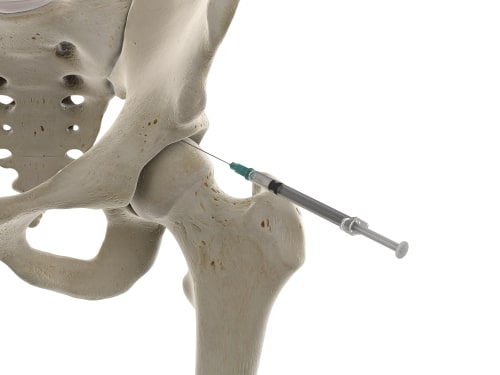
Are the side-effects and adverse reaction to cortisone over-reported?
The continuing controversy surrounding the use of cortisone injections for hip pain includes the debate over side-effects.
An August 2022 paper (6) suggested that there is conflicting data about the benefits and complications of Intraarticular corticosteroid injections and a lack of large studies with follow-up. This makes it difficult to determine the extent of the side-effect problem. In this study the researchers set out to determine the number of patients with complications after hip and knee Intraarticular corticosteroid injections in a large study sample with long-term follow-up.
In this study 500 patients who had corticosteroid injection in the hip and 500 patients who had corticosteroid injection in the knee were assessed for complication between one and 12 months after injection.
- Of the 1000 patients (mean age, 57 years old; 545 women),
- 10 patients (1%) developed severe complications.
- Four patients developed osteonecrosis;
- three, insufficiency fractures; and
- three, rapid progressive osteoarthritis.
- All 10 complications occurred between 2 and 9 months after injection: six (60%) in the hip and four (40%) in the knee.
- Of the included 1000 patients, 545 (54%) were women, but they had nine of the 10 (90%) complications
- Conclusion Intraarticular steroid injection had a substantially lower complication rate than that reported in previous smaller studies. The rate of severe complications was disproportionally higher in women than in men.
A study published in May 2025 (7) examined data from various studies that documented complications associated with hip cartilage due to a history of hip intra-articular corticosteroid injections. The analysis of 34,367 hips that underwent these injections indicated that the incidence of rapidly progressive osteoarthritis varied between 0.2% and 21.1%; osteonecrosis ranged from 0.6% to 27.1%; femoral head collapse was observed between 3.2% and 20.4%; insufficiency fractures occurred in a range of 0.4% to 1.3%; and the worsening of osteoarthritis was noted to be between 1.1% and 44.3%.
Related articles
Systemic effects of cortisone injections including cartilage damage
Exploring options
Free phone consultation
With nearly three decades of experience, Dr. Marc Darrow and his team are pioneers in regenerative treatments, offering expert insights and personalized care for hip pain.
Schedule a free phone consultation today with our staff and receive our exclusive Regenerative Medicine Stem Cell & PRP Quick Start Guide —a digital resource packed with:
- Insights into Stem Cell & PRP Therapy
- Research-backed treatments for chronic tendon injuries, joint pain, arthritis, and sports injuries
Take the first step toward a pain-free, active life today.
Call for a free phone consultation with our staff 800-300-9300
References
1 Angotti ML, Burnett RA, Khalid S, Terhune EB, Della Valle CJ. Intra-articular corticosteroids associated with increased risk of total hip arthroplasty at 5 years. HIP International. 2022 Jun 19:11207000221107225.
2 Rana P, Johnson A, Turcotte J, King P. Rapid Osteoarthritis and Femoral Head Collapse: A Case Series. Journal of Orthopaedic Case Reports. 2024 May;14(5):141.
3 Choueiri M, Chevalier X, Eymard F. Intraarticular Corticosteroids for Hip Osteoarthritis: A Review. Cartilage.:1947603520951634.
4 Chang CY, Mittu S, Da Silva Cardoso M, Rodrigues TC, Palmer WE, Gyftopoulos S. Outcomes of imaging-guided corticosteroid injections in hip and knee osteoarthritis patients: a systematic review. Skeletal Radiology. 2022 Dec 15:1-2.
5 Forlenza EM, Burnett RA, Korrapati A, Yang J, Forsythe B, Della Valle CJ. Preoperative Corticosteroid Injections Demonstrate a Temporal and Dose-Dependent Relationship with the Rate of Postoperative Infection Following Total Hip Arthroplasty. The Journal of Arthroplasty. 2021 Jun 1;36(6):2033-7.
6 Graf DN, Thallinger A, Zubler V, Sutter R. Intraarticular steroid injection in hip and knee with fluoroscopic guidance: reassessing safety. Radiology. 2022 May 10:210668.
7 Parry D, Dhillon J, Kraeutler MJ. Risks of Intra-Articular Hip Corticosteroid Injections Include Rapidly Progressive Osteoarthritis and Femoral Head Collapse in Patients With and Without Osteoarthritis: A Systematic Review. Arthroscopy, Sports Medicine, and Rehabilitation. 2025 May 21:101169.