







Marc Darrow, MD, JD.
In our practice we see many people with chronic ankle sprain who have a medical history including numerous ankle arthroscopic procedures. They will usually contact out office looking for options to their next surgery which would be an ankle fusion or a total ankle replacement. Why? Because chronic ankle instability is very common and unfortunately prone to re-injury or recurrent problems. Usually, someone being told they need one more surgery will lead these people to more exhaustively research alternatives. This includes the various types of ankle injections.
A July 2020 paper (1) compared various medicine injection treatments for ankle pain caused by osteochondral lesions (loss of cartilage leading to a bone on bone situation) and osteoarthritis. The injection treatments included were hyaluronic acid, Platelet-rich plasma (PRP), saline, methylprednisolone (steroid), botulinum toxin type A, mesenchymal stem cells (MSCs), and prolotherapy.
This was a review study where researchers combined studies and the study data to form an opinion on which of these treatments would work best. The problem with the results of this study? There were not enough studies of good evidence in direct comparisons of ALL the treatments for the researchers to review to give any opinion.
Also in 2020, (2) research lead by Harvard Medical School wrote: “Injection therapy may provide pain relief and improvement in the clinical condition but they do not come without certain limitations including potential failure. In the event that injections are not beneficial for the discussed syndromes, evaluation for surgical intervention may need to be obtained. While there appears to be positive outcomes due to injection-based treatment in small-scale trials, further studies are needed to evaluate the positive effects of injection-based treatment for chronic foot and ankle pain.”
A 2022 paper (3) followed up on this research to suggest: “The best evidence is currently available for viscosupplementation but the study situation for the use of platelet-rich plasma (PRP) is still not sufficiently comprehensive and there are only a few case reports on the use of mesenchymal stem cells.”
The different types of ankle pain injections – which shot works? Evidence is inconclusive.
While we then cannot offer a direct comparison of the treatments, we can review the research in this article where there is a direct comparison and give a broad over view of these treatments for ankle joint pain.
A May 2022 study (4) did offer this observation: “blood, cell-based, and injectable therapies such as PRP, platelet poor plasma biomatrix loaded with mesenchymal stromal cells, concentrated bone marrow aspirate, hyaluronic acid, and stem or stromal cell therapy including mesenchymal stem cell allografts, and adipose tissue-derived stem cells, and micronized adipose tissue injections” can be considered: “Promising and established treatment modalities.”
A September 2021 paper (5) added: “. . . some studies have investigated intra-articular injections for ankle osteoarthritis, and there is some evidence to suggest that hyaluronic acid or PRP may be effective in the short term for ankle osteoarthritis. Additionally, positive effects were observed in limited cases through the intra-articular injection of mesenchymal stem cells, but no high-quality evidence has been reported. In conclusion, the relative efficacy of injectable orthobiological therapies is far from a definitive recommendation, and robust comparative trials are needed.”
A study done in December 2025 (27) examined how effective PRP is for treating acute ankle sprains. The researchers looked at earlier published information and discovered that PRP had short-term advantages in lessening pain and enhancing function, especially when it was administered early and in multiple doses. Another comparative study focused on hyaluronic acid showed that it provided consistent and long-lasting benefits compared to a placebo, such as reducing pain, helping athletes return to sports faster, and decreasing the chances of sprains happening again. According to these findings, both PRP and hyaluronic acid could be useful as extra treatments for acute ankle sprains, mainly for quick relief and better function.
Botox injections for ankle pain vs hyaluronic acid injection – which shot works best?
In a study published in the Journal of foot and ankle research (6) investigators compared the effectiveness of intraarticular Botulinum toxin type A and intraarticular hyaluronate plus rehabilitation exercise in patients with ankle osteoarthritis over a 6 month period.
- Seventy-five patients with symptomatic ankle osteoarthritis grade 2 were randomized to receive either a single 100-unit Botulinum toxin type A injection into the target ankle or a single hyaluronate injection plus 12 sessions of rehabilitation exercise (30 minutes/day, 3 times/week for 4 weeks).
- There were no significant between-group differences in pain, disability and functional scores.
- Conclusions: Treatment with intraarticular Botulinum toxin type A or hyaluronate injection plus rehabilitation exercise was associated with improvements in pain, physical function and balance in patients with ankle osteoarthritis. These effects were rapid at 2 weeks and might last for at least 6 months. There was no difference in effectiveness between the two interventions.
There are many studies which favor the Botox injections in cases of Cerebral Palsy, post-stroke when there is neurological deficit, or in helping patients who had severe burns to their legs. The Botox helps with movement. At our practice, we do not treat these conditions.
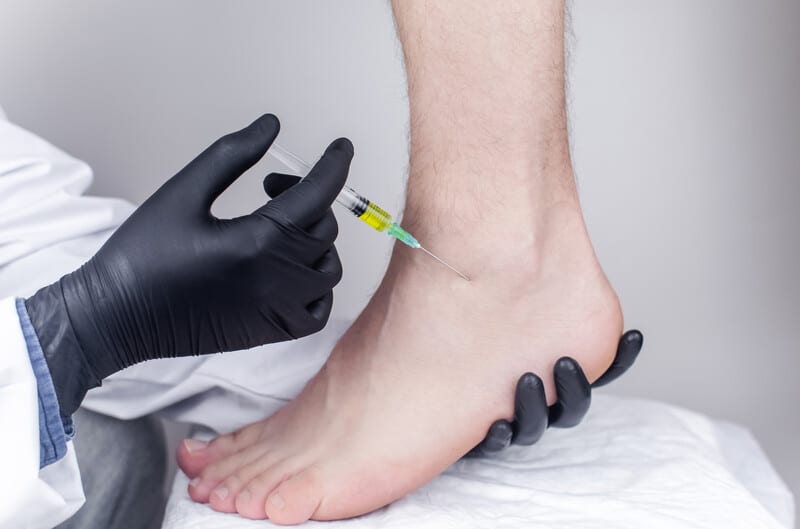
Hyaluronic acid injections for ankle pain and ankle arthritis
I often tell patients who come in with a lot of effusion (swelling) in a joint, that their effusion, that large amount of joint fluid, is hyaluronic acid. So why would you put in more hyaluronic acid with an injection of it? It’s already causing pain. In the early part of my practice I use to give hyaluronic acid injections. I did not get very good results with the health of the joints I was treating.
A September 2020 study (7) also examined the effectiveness of hyaluronic acid injections in varying stages of ankle arthritis. Here is what the paper said:
“Nonoperative measures are often used as first line treatment in ankle osteoarthritis. One of these measures consists of hyaluronic acid injections in the affected ankle joint, but efficiency of this treatment is uncertain. The purpose of the study was to evaluate the effect on Self-reported Foot and Ankle Score, visual analog (pain) scale score at rest, and visual analog (pain) scale score at activity 6 months after a single dose of hyaluronic acid in patients with ankle osteoarthritis.
Fifteen 15 patients were included for analysis. Median Self-reported Foot and Ankle Score remained unchanged (no improvement), whereas visual analog score at activity went from and visual analog score at rest showed small improvement. Subgroup analysis on arthrosis grade (grade I-II and III-IV) showed no statistically significant changes for all variables even though patients with grade III-IV degenerative arthritis seemed to benefit more from the treatment.
The results indicate that a single injection of hyaluronic acid is insufficient to produce at clinically relevant response after 6 months.”
A 2017 paper (8) documented that although few studies are present in the literature about the use of local viscosupplementation in ankle osteoarthritis, viscosupplementation’s potential use for ankle osteoarthritis has been suggested and recommended. The researchers write: “Although randomized trials showed scores improvement also in placebo-treated patients, current evidence suggests that viscosupplementation for treatment of ankle osteoarthritis is a safe and effective method. More randomized controlled trials with a large number of patients that compare not only the different types, dosages and frequency of Hyaluronic acid injection, but also the effectiveness of Hyaluronic acid versus corticosteroids infiltrations and Hyaluronic acid injection versus other types of conservative treatment are still needed.”
Cortisone Injections for ankle pain
Remarkably there is very little research on the effectiveness of cortisone for ankle pain. A study from October 2018 (9) recorded these observations:
- “Intra-articular injections are commonly used to treat knee arthritis pain; however, whether their efficacy generalizes to ankle arthritis remains debatable.”
When these researchers compared cortisone to hyaluronic acid, PRP, and stem cell injections, they found the effects of cortisone may only be short term and the “Evidence from small trials favors hyaluronic acid and PRP injections for the treatment of pain associated with ankle osteoarthritis.” At the time of this study, the researchers could not find enough research on stem cell therapy to make a recommendation for ankle injury I cover this below.
A 2022 paper relied on a 2008 study (10) to suggest corticosteroid could “provide short-term symptomatic relief lasting between 4 and 8 weeks. According to the available body of evidence, they should be reserved for persistent pain in higher-grade osteoarthritis with a maximum of three or four injections a year, because of the damaging effect to the joint cartilage.”(11)
A March 2025 study (25) writes: “Intra-articular corticosteroid injections are commonly used to treat osteoarthritis, both in the foot and ankle and elsewhere in the body, but clinical practice is highly variable,” and “Over recent years, there has been a growing awareness of potential detrimental effects of intra-articular corticosteroid injections including chondrotoxic effects and accelerated osteoarthritis progression, subchondral insufficiency fractures, osteonecrosis and increased risk of prosthetic joint infection, although the evidence is not robust.” However, repeated “intra-articular corticosteroid injections may provide some improvements in pain, function and quality of life up to 24 months after administration, they did not outperform placebo or other injectables at 12 and 24 months.” Future research is needed to address fundamental questions around the use of intra-articular steroids in the foot and ankle. Key uncertainties include: whether these treatments are clinically- and cost-effective, which products should be injected, whether imaging guidance improves outcomes, whether injected corticosteroids delay time to surgical treatment or whether they increase the likelihood of adverse events, such as post-injection infection.
Prolotherapy
A study published in December 2025 (26) looked into whether dextrose prolotherapy injections given to the anterior talofibular ligament could help with chronic ankle instability. A total of 114 people who had chronic ankle instability were randomly divided into two groups: one received dextrose prolotherapy and the other received normal saline, with a 1:1 ratio. Both groups got injections of 5 ml of 15% dextrose or 5 ml of normal saline into the anterior talofibular ligament at weeks 0, 4, 8, and 16. Prolotherapy works better than saline injections for improving balance over time, specifically at 26 and 52 weeks, and it also led to fewer re-sprains by 52 weeks.
Bone marrow aspirate concentrate
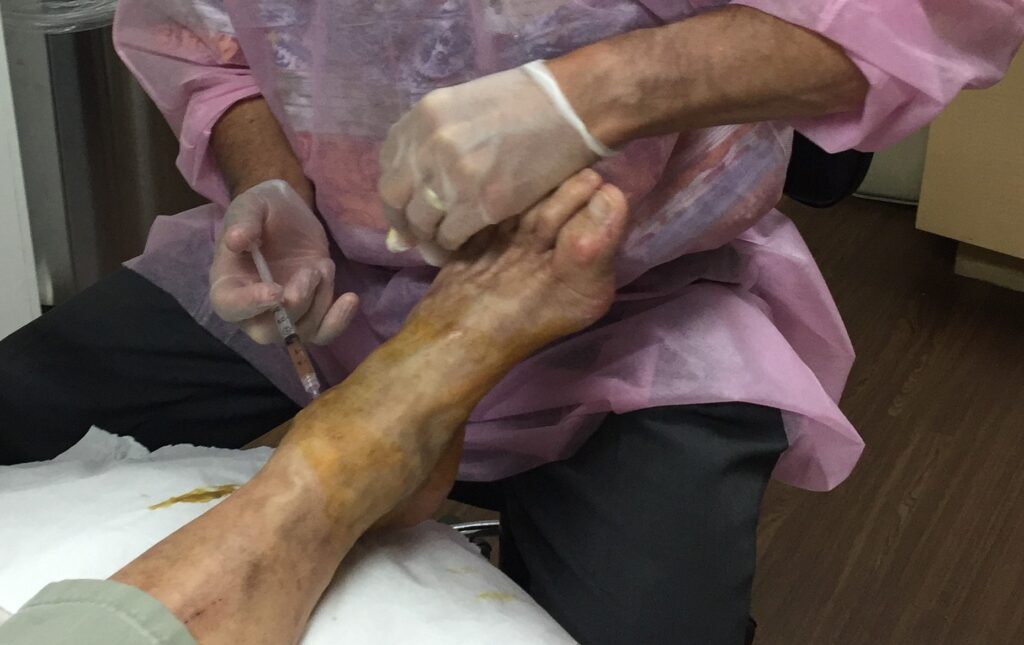
I have a more comprehensive article on this site Alternatives to ankle fusion and ankle replacement surgery.
Here is a summary of that article:
December 2016 research in the Journal of experimental orthopaedics from doctors at the Steadman Philippon Research Institute (14) reviewed the research in the treatment of ankle osteoarthritis with bone marrow derived cells.
- The goal of this study was to review outcomes of bone marrow aspirate concentrate (bone marrow derived cells) for the treatment of chondral (cartilage) defects and osteoarthritis of the talus of the ankle. The researchers noted that there is not much research (at the time of this paper’s writing). . . Nonetheless, the evidence available showed varying degrees of beneficial results of bone marrow derived stem cell therapy for the treatment of ankle cartilage defects (arthritis). The researchers hypothesized that bone marrow aspirate concentrate may be useful in regeneration of tissue, enhancing the quality of cartilage repair. As a result, BMAC promotes a potentially healthy environment for hyaline cartilage growth and repair. The health of cartilage is one of the goals of this type of medicine.
Research cited:
- A 2009 study published in Clinical Orthopaedics and Related Research, reported that 94 % of patients returned to low impact sports activity at an average 4.4 months after bone marrow aspirate transplantation and 77 % of patients returned to high impact sports activity at an average 11.3 months. (15)
- The same researchers in 2013 reported that 73 % of the 36 patients playing sports before surgery were able to return to sports. They also reported that 22 % of these 36 patients were able to return to sport, but at a lower level than before surgery. (16)
- A 2011 study reported that 95 % of patients who had undergone bone marrow concentrate treatments returned to their pre-symptom level of sporting activity at an average 13 weeks.(17)
A heavily cited and received 2015 study showed that stem cell treatments were able to regrow cartilage in ankles significant enough to improve function and pain levels in selected patients. Walking distances were shown to dramatically improve in the patient group.(18)
In a post-surgical study from December 2018, (19) researchers found the injection of bone marrow mesenchymal stem cells could improve the repair process of the osteonecrosis.
In our office we evaluate every patient to offer a recommendation as to which healing program would be most beneficial to them. We do this after an assessment of their ankle pain, history of ankle instability and ankle sprain, level of arthritis, overall condition of the ankle joint and the realistic expectation of successful care.
Contact us and related articles
If you have chronic ankle pain, have had painkillers, physical therapy, and other conservative care options that have not helped, and, now you are being told to have surgery. We may be able to help reduce pain and increase function.
Regenerative medicine injections may be an alternative for you. Many people benefit from these treatments, but, they do not work for everyone. Will it work for you?
Call for a free phone consultation with our staff.
800-300-9300 or 310-231-7000 or email
Other articles
Continued ankle instability after arthroscopic lateral ligament repair | Joint Rehab Los Angeles
Stem cell therapy and ankle osteoarthritis injections | Joint Rehab Los Angeles
Citations for this article:
1 Boffa A, Previtali D, Frattura GD, Vannini F, Candrian C, Filardo G. Evidence on ankle injections for osteochondral lesions and osteoarthritis: a systematic review and meta-analysis. International Orthopaedics. 2020 Jul 9:1-5.
2 Urits I, Smoots D, Franscioni H, Patel A, Fackler N, Wiley S, Berger AA, Kassem H, Urman RD, Manchikanti L, Abd-Elsayed A. Injection techniques for common chronic pain conditions of the foot: a comprehensive review. Pain and therapy. 2020 Jun;9(1):145-60.
3 Jerosch J. Conservative treatment options for arthritis of the ankle: What is possible, what is effective?. Der Unfallchirurg. 2022 Jan 18.
4 Danilkowicz R, Murawski C, Pelligrini M, Walther M, Valderrabano V, Angthon C, Adams S. Nonoperative and Operative Soft-Tissue and Cartilage Regeneration and Orthopaedic Biologics of the Foot and Ankle: An Orthoregeneration Network (ON) Foundation Review. Arthroscopy: The Journal of Arthroscopic & Related Surgery. 2022 May 21.
5 Tejero S, Prada-Chamorro E, González-Martín D, García-Guirao A, Galhoum A, Valderrabano V, Herrera-Pérez M. Conservative Treatment of Ankle Osteoarthritis. Journal of Clinical Medicine. 2021 Jan;10(19):4561.
6 Sun SF, Hsu CW, Lin HS, Chou YJ, Chen JY, Wang JL. Efficacy of intraarticular botulinum toxin A and intraarticular hyaluronate plus rehabilitation exercise in patients with unilateral ankle osteoarthritis: a randomized controlled trial. Journal of foot and ankle research. 2014 Dec 1;7(1):9.
7 Jantzen C, Ebskov LB, Andersen KH, Benyahia M, Rasmussen PB, Johansen JK. The Effect of a Single Hyaluronic Acid Injection in Ankle Arthritis-A Prospective Cohort Study. The Journal of Foot and Ankle Surgery. 2020 May 29.
8 Papalia R, Albo E, Russo F, Tecame A, Torre G, Sterzi S, Bressi F, Denaro V. The use of hyaluronic acid in the treatment of ankle osteoarthritis: a review of the evidence. Journal of Biological Regulators and Homeostatic Agents. 2017 Dec 27;31(4 Suppl 2):91-102.
9 Vannabouathong C, Del Fabbro G, Sales B, Smith C, Li CS, Yardley D, Bhandari M, Petrisor BA. Intra-articular injections in the treatment of symptoms from ankle arthritis: a systematic review. Foot & ankle international. 2018 Oct;39(10):1141-50.
10 Ward ST, Williams PL, Purkayastha S. Intra-articular corticosteroid injections in the foot and ankle: a prospective 1-year follow-up investigation. The Journal of foot and ankle surgery. 2008 Mar 1;47(2):138-44.
11 Herrera-Pérez M, Valderrabano V, Godoy-Santos AL, de César Netto C, González-Martín D, Tejero S. Ankle osteoarthritis: comprehensive review and treatment algorithm proposal. EFORT Open Reviews. 2022 Jul 1;7(7):448-59.
14 Chahla J, Cinque ME, Schon JM, et al. Bone marrow aspirate concentrate for the treatment of osteochondral lesions of the talus: a systematic review of outcomes. Journal of Experimental Orthopaedics. 2016;3:33. doi:10.1186/s40634-016-0069-x.
15 Giannini S, Buda R, Battaglia M, Cavallo M, Ruffilli A, Ramponi L, Pagliazzi G, Vannini F. One-step repair in talar osteochondral lesions: 4-year clinical results and t2-mapping capability in outcome prediction. The American journal of sports medicine. 2013 Mar;41(3):511-8.
16 Giannini S, Buda R, Battaglia M, Cavallo M, Ruffilli A, Ramponi L, Pagliazzi G, Vannini F. One-step repair in talar osteochondral lesions: 4-year clinical results and t2-mapping capability in outcome prediction. The American Journal of Sports Medicine. 2013 Mar;41(3):511-8.
17 Kennedy JG, Murawski CD. The Treatment of Osteochondral Lesions of the Talus with Autologous Osteochondral Transplantation and Bone Marrow Aspirate Concentrate: Surgical Technique. Cartilage. 2011 Oct;2(4):327-36. doi: 10.1177/1947603511400726. PMID: 26069591; PMCID: PMC4297142.
18 Emadedin M, Ghorbani Liastani M, Fazeli R, et al.Long-Term Follow-up of Intra-articular Injection of Autologous Mesenchymal Stem Cells in Patients with Knee, Ankle, or Hip Osteoarthritis. Arch Iran Med. 2015 Jun;18(6):336-44. doi: 015186/AIM.003.
19 Hernigou P, Dubory A, Lachaniette CH, Khaled I, Chevallier N, Rouard H. Stem cell therapy in early post-traumatic talus osteonecrosis. International orthopaedics. 2018 Dec 1;42(12):2949-56.1767–2107
25 Jones K, Bruce J, Lewis TL, Nolan CN, Munteanu SE, Menz HB, Backhouse MR. Intra-articular corticosteroid injections for the treatment of people with foot and ankle osteoarthritis: a systematic review. Rheumatology Advances in Practice. 2025 Mar 11:rkaf030.
26 Sit RW, Wu RW, Reeves KD, Chan DC, Fung CL, Wang B, Law SW, Yip BH, Rabago D. Dextrose Prolotherapy injection improves dynamic postural balance and reduces risk of recurrent sprains in Chronic Ankle Instability: A one-year randomized placebo-controlled trial. Archives of Physical Medicine and Rehabilitation.
27 Chen YT, Wu WT, Lee RP, Yu TC, Chen H, Yeh KT. Platelet-rich plasma and hyaluronic acid in the treatment of acute ankle sprains: A review. Biomolecules and Biomedicine. 2025 Dec 3.