







Marc Darrow, MD. Joint Rehab Los Angeles
Patients sometimes come to us with pain that travels from the lower back or buttock into the leg. Some have been told they have sciatica. Others have already undergone a spinal operation and are trying to understand why they still hurt.
The first question is what is generating the pain now. A diagnosis made before surgery, or a finding on an MRI, does not automatically explain the current symptoms. At the same time, persistent leg pain should not automatically be attributed to a ligament or muscle. Nerve compression, joint pain, and soft-tissue pain can overlap.
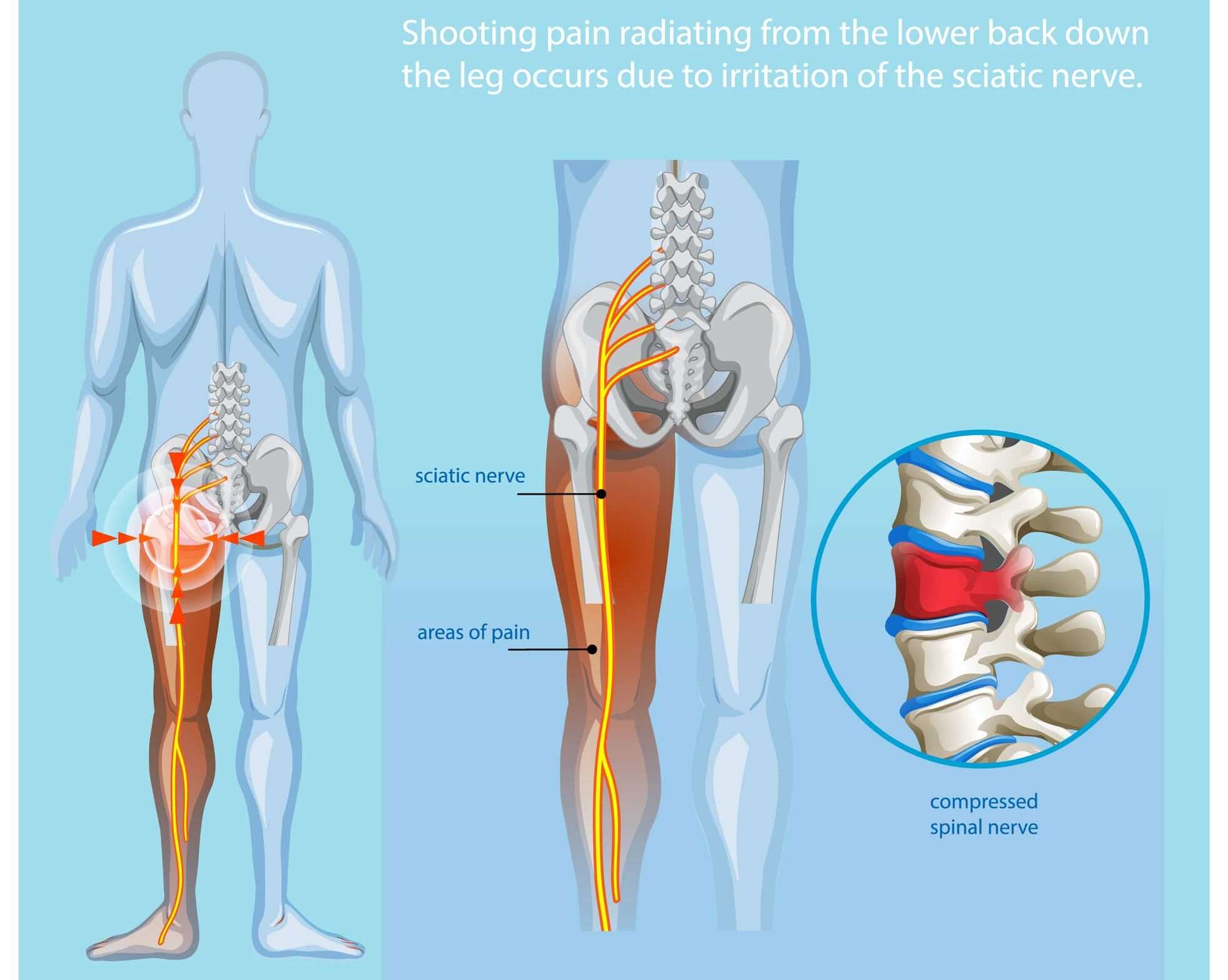
Understanding Sciatica and Its Symptoms
Sciatica, radicular pain, and referred pain are different descriptions
Sciatica commonly describes pain extending down the leg in a pattern associated with irritation of a lumbar nerve root or the sciatic nerve. A disc herniation or spinal narrowing can contribute. Radiculopathy refers to nerve-root dysfunction, which may produce weakness, sensory changes, or altered reflexes. Radicular pain can occur without all of those findings.
Pain can also travel from a musculoskeletal structure without a nerve root being the primary source. This is referred pain. A 2025 review describes conditions that can mimic or coexist with radiculopathy, including hip arthritis, greater trochanteric pain, myofascial pain, and other disorders. (1)
Why examination matters even when you have an MRI
The examination helps connect the symptoms with the anatomy. It considers sensation, strength, reflexes, walking, spinal and hip movement, and the activities that bring on pain. That information can support—or challenge—the explanation suggested by a scan.
Degenerative findings are common in people without back pain. A systematic review of 3,110 asymptomatic individuals found that disc degeneration and bulging became increasingly common with age. These findings need clinical interpretation. (2)
This does not make MRI irrelevant. A scan can identify important compression or another structural problem. The useful question is whether its location and severity fit the symptoms and examination. JointRehab’s discussion of MRI findings and decisions about back surgery explores that issue further.
Electromyography and nerve-conduction testing may help distinguish nerve-root dysfunction from peripheral nerve disorders when the diagnosis is uncertain. They are not mandatory for every patient with sciatica, and a normal study does not exclude every cause of radicular pain.
What changes after back surgery?
Persistent pain after surgery is sometimes called failed back surgery syndrome or post-laminectomy syndrome. The term persistent spinal pain syndrome type 2 is increasingly used because it describes the problem without assuming that every painful outcome reflects a failed procedure.
A 2024 review identifies several possible sources: recurrent or residual structural disease, incomplete fusion, adjacent-level problems, altered mechanics, muscle wasting, scar-related processes, and persistent nerve pain. In some patients, the explanation remains uncertain. (3)
The distinction between unchanged pain, new pain, and pain that returned after an initial improvement matters. It can help determine which possibilities deserve investigation. None of those patterns, by itself, proves a particular cause.
JointRehab has a detailed postoperative back-pain article covering surgical outcomes and treatment options. The purpose here is to connect that broader discussion with the specific problem of radiating pain and the evidence for regenerative injections.
The SI joint, muscles, and neighboring spinal levels
After fusion, assessment may need to extend beyond the operated level. A 2024 systematic review of twelve observational studies involving 3,570 patients estimated new-onset sacroiliac joint pain after spinal surgery at approximately 9.4%. Multilevel surgery and fusion to the sacrum were among associated factors. The findings do not establish the cause of an individual’s pain. (4)
The SI-joint assessment article explains why symptoms in that region need careful differentiation.
Muscles and fascia also deserve attention. JointRehab’s article on postsurgical muscle changes discusses muscle health after fusion. Such changes can be relevant without proving that muscle damage explains every case or that an injection reverses muscle atrophy.
Likewise, imaging degeneration next to a fusion is different from symptomatic adjacent segment disease. A neighboring level needs to fit the clinical problem before it is selected for treatment. The adjacent segment disease article addresses this distinction in more detail.
Nonsurgical care still has a role
Treatment after surgery may include rehabilitation, medicines selected for the pain mechanism, and specific interventions when appropriate. Persistent pain can also affect sleep, confidence in movement, and daily function. Addressing these consequences does not mean that the pain is imaginary.
A 2024 review emphasizes identifying the cause, setting realistic goals, and using a multidisciplinary approach when needed. It includes physical therapy, medication, psychological support, and interventions rather than presenting repeat surgery as the default response. (5)
For someone considering PRP or marrow treatment, the relevant issue is whether there is a suitable target and a reasonable evidence-based expectation. Having exhausted one treatment does not establish that the next injection will work.
What does research show about PRP for true lumbar radicular pain?
PRP is prepared from the patient’s blood and concentrates platelets. It is not a stem cell treatment. Its effects depend on the preparation, injection route, and condition being studied.
A 2025 meta-analysis of five randomized trials involving 310 patients compared epidural PRP with epidural steroid injections for lumbar disc disease with radiculopathy. Average pain and disability outcomes were comparable, with substantial variation between studies. (6)
A separate 2026 meta-analysis of three trials involving 132 patients found that steroids performed better for pain at one month, while PRP performed better for pain and disability at six months. This smaller analysis used a different selection of trials; it should not be interpreted as an independent population added to the earlier review. (7)
An October 2026 randomized trial enrolled 107 patients with a single-level herniated disc and symptoms persisting despite six weeks of conservative treatment. Steroid injections produced better early outcomes, while PRP produced better pain and disability outcomes at six and twelve weeks. Follow-up was short, and the trial did not establish long-term nerve repair or effectiveness for postoperative patients. (8)
Together, these studies provide a clinical signal worth investigating. They do not establish PRP as a universal replacement for steroid injections or surgery. Nor does symptom improvement show that a herniation disappeared or that mechanical compression was removed.
Bone marrow treatment: the target changes the evidence
Bone marrow aspirate concentrate contains a mixture of cells and other components. Its stromal-cell population is different from a purified, culture-expanded cell product. This article considers non-expanded preparations.
In our 2018 four-patient series, marrow concentrate was injected into lumbar-region muscle, fascia, and ligament attachments. Patients reported improvement at one year. These observations support further investigation, but the study had no control group and could not establish tissue regeneration or effectiveness for nerve compression. (9)
In contrast, a 2025 double-blind trial tested marrow concentrate injected inside a disc in 63 patients with presumed discogenic back pain. It found no statistically significant advantage over a sham procedure in the primary pain-relief outcome. Limited characterization of the preparation was among the study’s limitations. (10)
Neither study answers every spine-treatment question. An injection into a disc, an epidural injection near a nerve root, and an injection into a soft-tissue attachment are different procedures. Their outcomes should not be grouped together as proof that “stem cells work for sciatica.”
Evidence for knee arthritis, donor cord products, or Wharton’s jelly also cannot establish effectiveness for postoperative lumbar nerve pain. The actual preparation and target need to match the research.
When surgery remains appropriate
Some patients improve with nonsurgical care; others have a structural problem for which surgery is appropriate. A 2023 systematic review found that discectomy could provide faster leg-pain relief for patients with a surgical indication, although benefits over nonsurgical treatment diminished over time and evidence certainty was low. (11)
Progressive weakness, a new foot drop, saddle numbness, or changes in bladder or bowel function require prompt assessment. A regenerative-treatment discussion should never delay evaluation of a potentially serious neurologic problem.
For elective repeat surgery, the key question is whether the proposed procedure addresses a clearly identified cause that fits the symptoms. Avoiding unnecessary surgery and recognizing necessary surgery are both part of good decision-making.
What matters more than age or where treatment is offered?
Being over 50 does not determine the pain source or automatically rule out nonsurgical options. Medical history, neurologic status, structural disease, and the person’s goals matter more than an age cutoff.
Likewise, travel abroad is not evidence that a product or procedure is more effective. The evidence, processing, oversight, and follow-up arrangements matter. FDA guidance states that regenerative therapies have not been approved for orthopedic conditions and warns about unapproved products marketed for these uses. (12)
The central question remains: what is producing the current pain, and what treatment has credible evidence for that problem? A better explanation of the symptoms makes the next decision more useful than another label on a scan.
More reading
References
- Bateman EA, Fortin CD, Guo M. Musculoskeletal mimics of lumbosacral radiculopathy. Muscle Nerve. 2025;71(5):816-832. doi:10.1002/mus.28106.
- Brinjikji W, Luetmer PH, Comstock B, Bresnahan BW, Chen LE, Deyo RA, Halabi S, Turner JA, Avins AL, James K, Wald JT, Kallmes DF, Jarvik JG. Systematic literature review of imaging features of spinal degeneration in asymptomatic populations. AJNR Am J Neuroradiol. 2015;36(4):811-816. doi:10.3174/ajnr.a4173.
- van de Minkelis J, Peene L, Cohen SP, Staats P, Al-Kaisy A, Van Boxem K, Kallewaard JW, Van Zundert J. 6. Persistent spinal pain syndrome type 2. Pain Pract. 2024;24(7):919-936. doi:10.1111/papr.13379.
- Xu C, Lin X, Zhou Y, Zhuo H, Yang L, Chai X, Huang Y. Incidence and risk factors of new-onset sacroiliac joint pain after spinal surgery: a systematic review and meta-analysis. PeerJ. 2024;12:e18083. doi:10.7717/peerj.18083.
- Yeo J. Failed back surgery syndrome-terminology, etiology, prevention, evaluation, and management: a narrative review. J Yeungnam Med Sci. 2024;41(3):166-178. doi:10.12701/jyms.2024.00339.
- Muthu S, Viswanathan VK, Gangadaran P. Is platelet-rich plasma better than steroids as epidural drug of choice in lumbar disc disease with radiculopathy? Meta-analysis of randomized controlled trials. Exp Biol Med (Maywood). 2025;250:10390. doi:10.3389/ebm.2025.10390.
- Ermawan R, Corrigan H, Fachreza MS, Mercy G, Angeline A, Jiwandono BS, Yudistiro I, Abdulhamid M. Epidural Platelet-Rich Plasma Long-Term Outcome Is Better Than Steroid for Prolapsed Lumbar Intervertebral Discs: A Meta-Analysis of Randomized Controlled Trials. Spine Surg Relat Res. 2026;10(1):36-42. doi:10.22603/ssrr.2025-0007.
- Sonkar T, Yadav V, Singh S. A randomized controlled trial comparing transforaminal injections of Platelet-rich plasma versus steroid for lumbar herniated disc. J Clin Orthop Trauma. 2026;81:103546. doi:10.1016/j.jcot.2026.103546.
- Darrow M, Shaw B. Treatment of Lower Back Pain with Bone Marrow Concentrate. Biomed J Sci Tech Res. 2018;7(2). Article 001461. doi:10.26717/BJSTR.2018.07.001461.
- Levi D, Tyszko S, Horn S, Pham N, Levin J. Bone marrow concentrate intradiscal injection for chronic discogenic low back pain: A double-blind randomized sham-controlled trial. Interv Pain Med. 2025;4(3):100611. doi:10.1016/j.inpm.2025.100611.
- Liu C, Ferreira GE, Abdel Shaheed C, Chen Q, Harris IA, Bailey CS, Peul WC, Koes B, Lin CC. Surgical versus non-surgical treatment for sciatica: systematic review and meta-analysis of randomised controlled trials. BMJ. 2023;381:e070730. doi:10.1136/bmj-2022-070730.
- U.S. Food and Drug Administration. Important Patient and Consumer Information About Regenerative Medicine Therapies. FDA consumer guidance. Accessed October 12, 2026.