







Marc Darrow, MD, JD
Pain on the thumb side of the wrist can make ordinary tasks surprisingly difficult: lifting a child, gripping a handle, opening a jar, or using a phone. Some people have already tried a brace, medication, or a steroid injection and are looking for another option. Others have been told they may need surgery.
Before comparing treatments, I would want to establish whether the problem is actually de Quervain’s tenosynovitis. Thumb arthritis, tendon problems, and nerve irritation can produce overlapping symptoms. A treatment aimed at the wrong structure may disappoint even when it is performed accurately.
There are useful nonsurgical options, and PRP research has expanded. However, promising symptom improvements should be distinguished from proof of tendon regeneration, and surgery remains appropriate for selected persistent cases. The decision should reflect the diagnosis, what has already been tried, and the strength of the evidence.
What is de Quervain’s tenosynovitis?
De Quervain’s affects the first dorsal compartment, a narrow passage on the thumb side of the wrist. The abductor pollicis longus (APL) and extensor pollicis brevis (EPB) tendons pass through it. These tendons help move the thumb away from the hand and straighten it.
The tendons need to glide as the thumb and wrist move. Thickening and irritation of their surrounding tissues can restrict that movement and cause pain. Although “tenosynovitis” suggests inflammation of the tendon sheath, a longstanding problem should not be understood as inflammation alone; tissue thickening and mechanical restriction also matter.
Symptoms commonly center near the radial styloid—the bony prominence on the thumb side of the wrist. Gripping, lifting, thumb movement, and bending the wrist can provoke pain. Swelling or a catching sensation may occur. The location and the movements that reproduce symptoms help guide examination, but none is a diagnosis by itself.
Is the pain coming from the thumb, the wrist, or a nerve?
The original article raised an important point: patients may describe pain in this region differently, and more than one condition can coexist. That distinction belongs in the assessment.
| Possible source | Features that may guide the examination |
|---|---|
| De Quervain’s tenosynovitis | Tenderness over the first dorsal compartment; pain with thumb use and selected wrist movements |
| Thumb carpometacarpal arthritis | Pain centered at the thumb-base joint, often during pinch or grip |
| Flexor carpi radialis tendinopathy | Pain on the palm-side, thumb-side wrist, particularly with resisted wrist flexion |
| Intersection syndrome | Pain and sometimes crepitus farther up the back of the forearm |
| Superficial radial nerve irritation | Burning, tingling, or altered sensation over the back of the thumb-side hand |
| Carpal tunnel syndrome | A different nerve distribution, often with tingling in the thumb, index, and middle fingers |
Flexor carpi radialis pain is worth preserving in this discussion because the tendon runs near the painful region. However, it is on the volar, or palm-side, aspect of the wrist, rather than the back of the wrist. It can be confused with de Quervain’s or coexist with it.
Numbness should not simply be attributed to a tight tendon sheath. It may indicate a nerve problem or an overly restrictive brace. A clinician can determine whether examination, X-rays, ultrasound, or another investigation is appropriate.
Finkelstein’s test and Eichhoff’s maneuver are not identical
The familiar maneuver of placing the thumb inside a fist and bending the wrist toward the little finger is commonly called Finkelstein’s test, but it is more accurately described as Eichhoff’s maneuver. The original page used the familiar name for that maneuver.
A study of 36 asymptomatic participants, involving 72 wrists, found that Finkelstein’s test produced fewer false-positive results and less discomfort than Eichhoff’s maneuver. Because the participants did not have the disease, the study does not establish sensitivity in symptomatic patients. (1)
This is more than a naming issue. A forceful maneuver can hurt structures that are not the source of the usual complaint. A positive result should be interpreted alongside tenderness, symptom location, and the rest of the examination. Repeatedly provoking severe pain at home is not a useful way to confirm the diagnosis.
When does ultrasound help?
Many straightforward cases can be diagnosed clinically. Ultrasound can help when the diagnosis is uncertain, symptoms persist, or an injection is being considered. It may show tendon-sheath or retinacular thickening and identify a partition, or septum, separating tendon subcompartments.
A 2022 systematic review found that anatomical variations were important in de Quervain’s management. A septum was more common in the surgical de Quervain’s population than in general cadaveric samples. The review also reported improved injection accuracy with ultrasound guidance. These findings support attention to anatomy, rather than a promise that guidance guarantees success. (2)
If a prior injection did not help, possibilities include an alternative diagnosis, an untreated subcompartment, persistent mechanical restriction, or lack of response despite appropriate placement. It should not automatically be assumed that a stronger or more expensive product is needed.
The site’s ultrasound-guidance article explains procedural guidance more broadly. Seeing where a needle goes and establishing that the treatment works are separate questions.
“Mommy thumb” is not limited to mothers
De Quervain’s is associated with pregnancy and the postpartum period, and repeated infant care can aggravate symptoms. Lifting or holding a baby with the thumbs spread and wrists bent may repeatedly load the painful area.
The nickname “mommy thumb” should not imply that the condition occurs only in new mothers. Fathers, other caregivers, workers, and athletes can develop similar symptoms. Nor should it imply that every postpartum patient caused the condition through incorrect lifting.
Where practical, modifying the way an object or child is supported can reduce repeated provocation. A hand therapist can help relate activity changes to the tasks that matter. If symptoms are severe or persistent, the solution may involve more than simply being told to rest.
Splints, activity modification, and medication
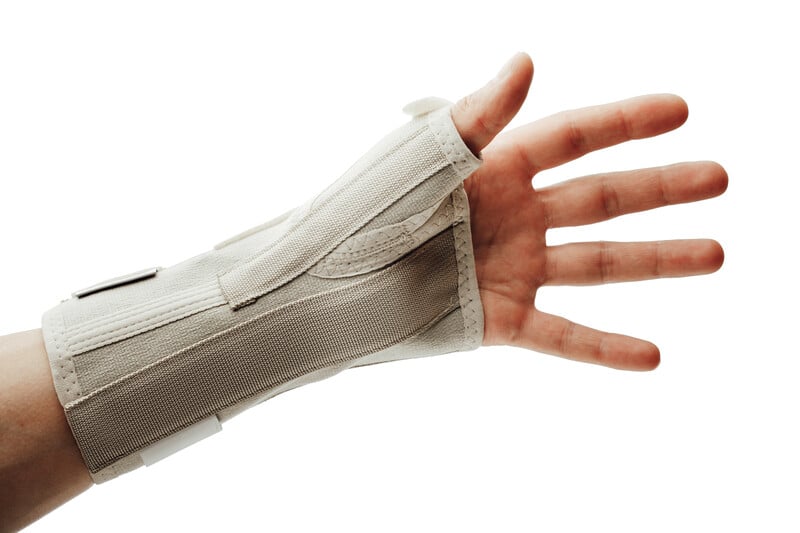
A thumb-spica orthosis supports both the thumb and wrist. A wrist-only support may not sufficiently limit the thumb movement that provokes symptoms. Fit matters: excessive pressure, numbness, or worsening pain warrants reassessment.
Activity modification aims to reduce repeated irritation while maintaining useful function. Returning immediately to the same painful gripping or lifting after a period of rest may reproduce symptoms. This helps explain why rest alone does not always provide lasting relief.
Anti-inflammatory medication may help pain and swelling, but it does not mechanically enlarge the compartment. Topical or oral treatment should be considered in light of medical history and medication risks. Symptom relief is a legitimate treatment goal even when structural repair has not been demonstrated.
A 2023 network meta-analysis included 30 studies and 1,663 patients. Corticosteroid injection combined with three to four weeks of thumb-spica immobilization ranked favorably. The additional functional improvement from immobilization was statistically significant but did not meet the authors’ threshold for clinical importance. (3)
A newer network meta-analysis, published online in 2025 and in a 2026 journal issue, also ranked orthosis plus corticosteroid injection highly. However, most included studies had high risk of bias, and certainty was low to very low. Rankings help summarize evidence; they do not identify the best treatment for every patient. (4)
Corticosteroid injections: benefit and risks both matter
Corticosteroid injection is an established treatment option. Some people obtain substantial relief; others have an incomplete response or recurrence. The original article’s discussion of risks remains relevant, but it should accompany the evidence of benefit.
Potential complications include a temporary pain flare, skin lightening, loss of subcutaneous fat, infection, and rare tendon injury. A 2019 surgical study discussed these steroid concerns, but its surgical series was not designed to calculate the complication rate of corticosteroid injection. (5)
It would therefore be misleading to use that paper to imply that serious injection complications are common. It would also be misleading to describe an injection as risk-free. Technique, the target, patient factors, and prior treatment need consideration.
Repeated injections should have a clear rationale. Recurring symptoms may justify reviewing the diagnosis and anatomy rather than indefinitely repeating a treatment that has provided little benefit.
What does PRP research show?
Platelet-rich plasma is prepared from a patient’s blood and contains concentrated platelets and their associated signaling substances. It is not a stem-cell preparation. Different processing systems and injection protocols produce different interventions.
The earlier page cited a broad 2023 PRP review describing a small comparison in which steroid performed better early and PRP performed better at a later assessment. New condition-specific reviews now provide a fuller picture.
A 2024 systematic review included 12 studies, but its pooled comparison with conservative treatment relied on only two studies involving 194 participants. Pain and wrist scores favored PRP at one and six months. That is encouraging, but the size and quality of the comparative evidence limit certainty about the magnitude and durability of benefit. (6)
A separate 2024 review included eight studies, comprising three randomized trials and five experimental studies. Its authors considered PRP promising but called for larger studies before recommending it as the treatment standard. The overlapping reviews should not be treated as independent sets of patients proving the same result repeatedly. (7)
New 2026 review: possible longer relief, with important uncertainty
An August 2026 systematic review compared PRP with corticosteroid injections across six studies. It reported improvements with both approaches and a signal favoring PRP for pain at six months. The authors emphasized small samples, low certainty, and marked study heterogeneity; the reported heterogeneity was approximately 99%. (8)
This supports discussing PRP as a possible option rather than declaring it proven superior for everyone. Six-month outcomes should not be translated into permanent relief. Differences in formulations, follow-up, and study methods also mean that a pooled result cannot guarantee a result from a particular clinic’s preparation.
The review reported fewer complications with PRP, but limited study size cannot reliably rule out uncommon harms. PRP still involves an injection and can cause pain, bleeding, infection, or injury to nearby structures.
Most importantly, better pain or function does not establish that the tendon regenerated or that a thickened compartment was structurally restored. Biological mechanisms and clinical outcomes are related research questions, not interchangeable proof.
What about stem cells, marrow, or Wharton’s jelly?
Bone marrow concentrate, fat-derived preparations, and donor umbilical-cord products differ from PRP and from one another. The PRP studies above cannot establish that those products are equally effective for de Quervain’s.
The evidence reviewed here does not provide a basis for presenting marrow or Wharton’s jelly as an established substitute for conventional treatment or surgical release. Research using culture-expanded cells has not been included as support for non-expanded preparations.
A proposed injection should identify the actual preparation, the anatomical target, and the diagnosis-specific evidence. “Regenerative” is a description of an intended approach, rather than a guarantee of tissue repair.
Manual therapy and exercise: preserving the original learning point
The original article discussed a three-patient case series, and that information remains useful when its limitations are clear. Treatment combined thumb-base joint manipulation and mobilization, wrist techniques, strengthening, and grip-proprioception training. All three patients improved, returned to daily activities without pain, and maintained improvement at six months. Each required ten visits or fewer. (9)
Because several treatments were combined without a control group, the report cannot identify which component helped or prove that manipulation is necessary. It also cannot establish a ten-visit recovery expectation for other patients.
The broader point is that rehabilitation can address function as well as symptoms. Progression should fit irritability, strength, and daily demands. Forceful stretching or manipulation is not automatically appropriate for every painful wrist, especially before trauma or another diagnosis has been excluded.
When does surgery become reasonable?
Surgical release creates more room in the first dorsal compartment. It may be discussed when a confirmed diagnosis continues to substantially limit function despite appropriate nonsurgical treatment. Anatomy matters because a separate subcompartment can require attention.
A 2022 systematic review of 21 studies and 939 patients found that most obtained substantial relief. Approximately 5% had residual pain, while the pooled complication rate was 11%, with a wide confidence interval and varied complications across studies. Those figures are group estimates, not an individual prediction. (10)
Potential problems include scar sensitivity, superficial radial nerve injury, tendon instability, infection, or incomplete relief. The original 2019 surgical series also reported nerve symptoms, scar problems, and recurrence. That information belongs alongside its favorable average functional outcomes. (5)
Avoiding unnecessary surgery is a reasonable goal. It should not become a promise that every persistent case can be resolved by injections. Likewise, a surgical opinion does not commit someone to an operation.
Why does treatment sometimes fail?
Persistent symptoms can reflect the wrong initial diagnosis, more than one pain source, continued aggravating activity, anatomical variation, or incomplete response to an appropriate treatment. Pain at the thumb-base joint, nerve symptoms, and a focal tendon-sheath problem need different consideration.
Treatment success should include useful tasks: lifting, gripping, work, childcare, or exercise. A short-term pain reduction may be meaningful, but a durable improvement also requires assessing what happens when those activities resume.
A rapidly red, hot, swollen wrist, fever, or symptoms after a puncture or bite need urgent assessment for infection. New pain after a fall, marked weakness, or persistent numbness also deserves examination rather than assuming a familiar tendon diagnosis.
De Quervain’s can often be treated without surgery. The evidence supports conventional care, while newer PRP research offers a possible additional option with unresolved questions. The most useful decision begins with a precise diagnosis and an honest discussion of what each treatment can—and cannot—be expected to achieve.
References
1 Wu F, Rajpura A, Sandher D. Finkelstein’s Test Is Superior to Eichhoff’s Test in the Investigation of de Quervain’s Disease. J Hand Microsurg. 2018;10(2):116-118. doi:10.1055/s-0038-1626690.
2 Abi-Rafeh J, Mojtahed Jaberi M, Kazan R, Alabdulkarim A, Boily M, Thibaudeau S. Utility of Ultrasonography and Significance of Surgical Anatomy in the Management of de Quervain Disease: A Systematic Review and Meta-Analysis. Plast Reconstr Surg. 2022;149(2):420-434. doi:10.1097/prs.0000000000008792.
3 Challoumas D, Ramasubbu R, Rooney E, Seymour-Jackson E, Putti A, Millar NL. Management of de Quervain Tenosynovitis: A Systematic Review and Network Meta-Analysis. JAMA Netw Open. 2023;6(10):e2337001. doi:10.1001/jamanetworkopen.2023.37001.
4 Cuenca-Zaldívar JN, Martínez-Pozas O, Riba E, Rouafi H, Ucero-Lozano R, Selva-Sarzo F, Sinatti P, Cadeau Comte N, Sánchez Romero EA. Conservative treatments for De Quervain’s tenosynovitis: A systematic review and network meta-analysis. J Hand Ther. 2026;39(3):479-495. doi:10.1016/j.jht.2025.09.001.
5 Mangukiya HJ, Kale A, Mahajan NP, Ramteke U, Manna J. Functional outcome of De Quervain’s tenosynovitis with longitudinal incision in surgically treated patients. Musculoskelet Surg. 2019;103(3):269-273. doi:10.1007/s12306-018-0585-1.
6 Hidajat NN, Magetsari RMSN, Steven G, Budiman J, Prasetiyo GT. Platelet-rich plasma for de Quervain’s tenosynovitis: A systematic review and meta-analysis. World J Orthop. 2024;15(9):858-869. doi:10.5312/wjo.v15.i9.858.
7 Alam M, Merza Abdulla Mohamed A, Alawainati M, Haider F. The Use of Platelet-Rich Plasma in De Quervain’s Tenosynovitis: A Systematic Review. Cureus. 2024;16(11):e74232. doi:10.7759/cureus.74232.
8 Abumadian AW, Binibrahim MI, Sultan AH, Addas MA, Bamagaus HY, Alhaddad SK, Bamabad MO, Ghalimah BA. The Use of Platelet-Rich Plasma for De Quervain’s Tenosynovitis: A Systematic Review With Limited Meta-Analysis. Saudi Med J. 2026;47(8):1265-1276. doi:10.15537/1658-3175.8818.
9 Young SW, Young TW, MacDonald CW. Conservative management of De Quervain’s tendinopathy with an orthopedic manual physical therapy approach emphasizing first CMC manipulation: a retrospective case series. Physiother Theory Pract. 2022;38(4):587-596. doi:10.1080/09593985.2020.1771800.
10 Bosman R, Duraku LS, van der Oest MJW, Hundepool CA, Rajaratnam V, Power DM, Selles RW, Zuidam JM. Surgical Treatment Outcome of de Quervain’s Disease: A Systematic Review and Meta-analysis. Plast Reconstr Surg Glob Open. 2022;10(5):e4305. doi:10.1097/gox.0000000000004305.